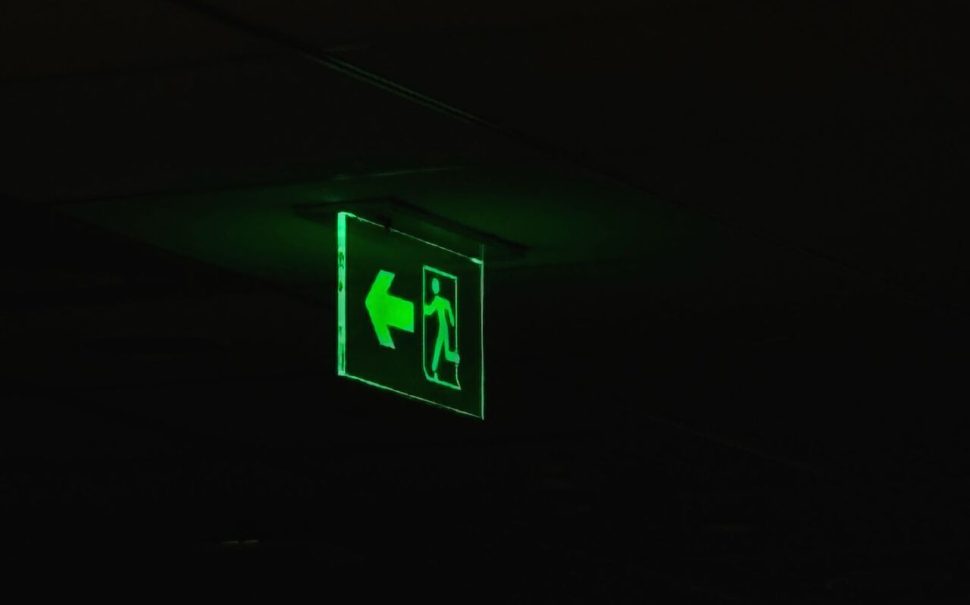
Photoluminescent is the official way to describe glow in the dark, where a light is absorbed and then emitted as to illuminate it when the lights go out. Facilities managers across the country who are reviewing escape routes will be weighing Photoluminescent Signs and Safety Way Guidance Systems against powered wayfinding, which hangs on the hope that the electrics (or battery) hasn’t been damaged. The debate between them starts with what the law asks of an escape route.
What the Fire Safety Order asks of an escape route
Article 14 of the Regulatory Reform (Fire Safety) Order 2005 is where the place to kick off from these are the main laws behind evacuation systems.
The responsible person ought to keep routes to emergency exits, and the exits themselves, clear at all times. Routes should lead as directly as possible to a place of safety, and their number, layout, size must suit the premises, its use and its maximum occupancy. Emergency doors should open in the direction of escape (typically not into the building, where there might be blockages or poor visibility), and sliding or revolving doors cannot serve as designated exits.
For signage specifically though, two clauses matter here.
- Emergency routes and exits “must be indicated by signs”
- Routes that need illumination must have emergency lighting of adequate intensity if the normal lighting fails
The Order names no technology for either duty – it doesn’t really care, as long as the empirical tests prove it to satisfy the clauses. People must be able to leave quickly and safely, and that means when the building has lost its supply.
Photoluminescent products fit that wording. As per Seton’s guidance on the category, these signs absorb light and then glow in the dark, which helps in a power cut or where smoke limits visibility. A sign that works without a circuit behind it addresses the failure the Order is inferring, even though it does not replace emergency lighting where a route needs illumination.
How ISO 16069 frames a guidance system
Facilities teams usually meet ISO 16069 next, which Seton, among other reputable suppliers, cite for its Safety Way Guidance Systems. The current edition was published on 10 November 2017 (replaced version 2004), now withdrawn. It sets out principles for designing and applying the visual components of a guidance system, covering both electrically powered and phosphorescent components, and gives type-specific information on environment of use, material choice, layout, installation, maintenance – the lot.
Tactile and audible components are very much outside its scope, and so too is high-mounted emergency escape route lighting. It does not cover risk assessment either as the final design is left to the responsible persons. In other words, the standard will not tell a site whether a stairwell needs a guidance system. The fire risk assessment does, and the standard then governs how the system is built.
Now we need to take a look at the Fire Industry Association’s 2013 guidance on fire safety signs. It lists a photoluminescent escape route sign as just one of the ways to meet the illumination requirement. It is an alternative to a maintained light source. It also gives placement rules:
- A sign at every change of direction
- Change of level and decision point
- Mounted 2.0 metres from the floor above doors or suspended from the ceiling
- 1.7 metres on walls.
A Safety Way Guidance System can be photoluminescent signs teamed up with marking tape that shows the route through corridors and down stairs – that’s what we see in the Seton examples. Because the route is marked continuously, people are guided to an exit rather than only told where one is. This is important in a frantic emergency, because it almost takes the decision out of the equation – you just follow the trail.
Over-signing, upkeep and who is accountable
It’s worth considering that the Health and Safety (Safety Signs and Signals) Regulations 1996 add the format, though – you can’t just illuminate any sign.
Schedule 1 reserves green for emergency escape (and first-aid signs) with a rectangular or square white pictogram on a green ground that covers at least half the sign. When natural light is poor, it wants phosphorescent colours, reflective materials or even just artificial lighting. Signs that need power must have a guaranteed emergency supply during a power cut, and a sign must come down once the situation it refers to no longer exists.
The Fire Industry Association guidance wants fire safety signs to be audited and reviewed periodically to confirm that they still support the strategy. They don’t prescribe an exact inspection interval.
Regulators also test how the guidance reaches people in an emergency. When HMICFRS inspected Greater Manchester Fire and Rescue Service in autumn 2023, it rated the service good in 10 of 11 areas and adequate on fire survival guidance – something Andy Burnham will be no doubt proud of.
Featured image credit: prasun_16 via Pexels
Join the discussion