In an exclusive data comparison of the location of Manchester United season ticket holders, we reveal how Manchester United’s season ticket base has become significantly less local over the past quarter of a century. Our findings raise fresh questions about affordability, identity and whether the club’s future risks leaving behind the community that built it.
In 2001, Manchester was a city in transition. Five years on from the 1996 IRA bombing of the city centre, the physical, economic and social rebuilding of the city had reshaped Manchester into a hub of new urban living developments, thriving music cultures and major public investment projects for the upcoming 2002 Commonwealth Games. Alex Ferguson’s Manchester United won their third consecutive Premier League title, and the atmosphere in the city was one of confidence and youthful optimism.
Ahead of the Commonwealth Games, a study by Manchester Metropolitan University was released which aimed to explore the ways that sport was being used as part of the economic and social regeneration of the city, and the relationship between the two biggest football clubs in Manchester, the city and their fans.
‘Do You Come From Manchester?’ by Dr Adam Brown was a postcode analysis of season ticket holders at Manchester United and Manchester City, which aimed to explore the stereotype of Manchester United being “unconnected to the city, with few local supporters and a fan base which is more national and international than Mancunian”. Through analysing the club’s season ticket data, the study concluded that the club retained strong local links and that “Despite the huge changes in football’s finance, organization and consumption in the last decade or so… hardcore support remains strongly regional and local.”
In November 2025, I approached Manchester United with the idea of doing a 25-year-on replication of the study, to explore whether the conclusions drawn still hold. The club kindly provided the season ticket data for the 2025/26 season in the same format as that used in the original. This has enabled me to undertake a direct comparison with the 2001 findings. The results show that those strong local and regional links have been significantly eroded in the intervening period, for reasons we will explore further in this article.
Given the study’s original aims, an updated comparison comes at a particularly pertinent point. Today, Manchester United have announced there will be a major update regarding their proposed new stadium. Both United and Trafford Council have lauded the stadium redevelopment project as a way to advance the economic and social regeneration of Wharfside, the area of Trafford Park in which United’s Old Trafford stadium currently sits.
The club aims to build a 100,000 seater stadium which will sit at the heart of a “regeneration zone”, but there are ongoing questions about who this new area will actually benefit – locals, or tourists. Concerns abound amongst Manchester United fans, particularly local ones, regarding ticket pricing at the proposed new stadium, and whether current matchgoing fans would be able to afford to access it. 25 years on from the original study, questions about the relationship between Manchester United, its fans and the city are once again in the headlines.
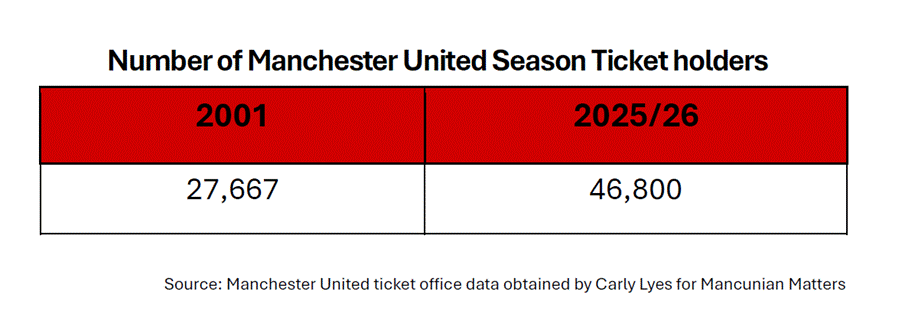
Since the 2001 study, the number of season tickets available at Old Trafford has increased by around 19,000, a 69% overall increase. In 2001, Old Trafford had a capacity of around 68,000, but according to the data, only 27,667 season tickets. The original data fails to mention League Match Ticket Books (LMTBs), essentially season tickets for league home games, without the additional guarantee of tickets for FA Cup, League Cup and European games. A direct comparison between the data from today and the data of 2001 season tickets and LMTBs combined may be a more representative comparison, however this data is unfortunately not available.
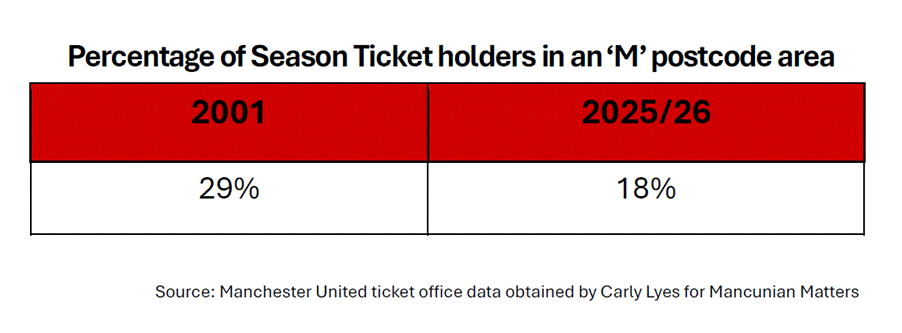
Perhaps the most pertinent finding overall is that the percentage of Manchester United season ticket holders resident in Manchester postcode areas – defined in the original study as those postcodes which start with an ‘M’ – has dropped from 29% to 18% since 2001. In terms of absolute figures, in 2001 there were approximately 7,800 Manchester-based season ticket holders – by 2025, even though there had been an increase of around 19,100 season tickets, there had only been an actual increase of around 800 season ticket holders in M postcodes.
Below is the breakdown of season ticket distribution across M postcodes in 2001 and 2025/26. Instead of showing absolute numbers in each area, the below table shows the percentage of all season ticket holders resident in that postcode area.
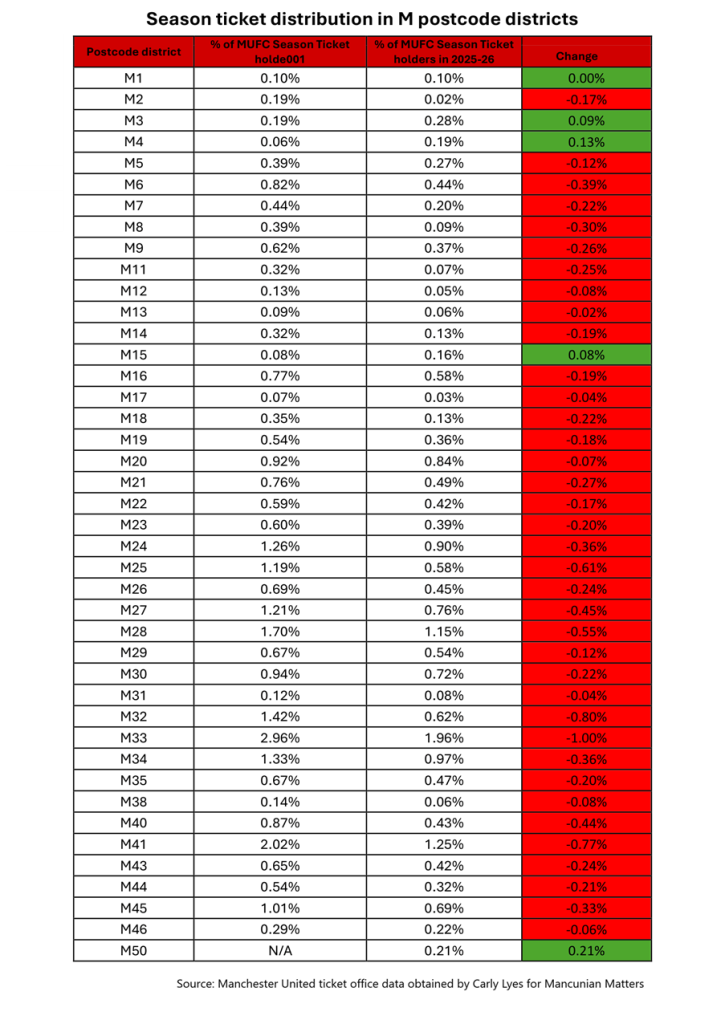
In the vast majority of M postcode areas, the proportion of season ticket holders resident in that area has declined since 2021. The only areas where numbers have stayed the same or increased have been in city centre areas where there has been significant population growth since 2001; M1, M3 and M4 city centre postcode districts and M15 Hulme district on the edge of the city centre seeing population increases of 13,000 – 27,000 according to the 2001 and 2021 Census data. M50, which covers Media City, just a few hundred yards from Old Trafford across the water at Salford Quays, didn’t exist in 2001.
In every other Manchester postcode area – where the population in almost every area has also grown by some degree between 2001 and 2021 – the proportion of overall Manchester United season ticket holders has decreased. In the areas immediately surrounding Old Trafford, season ticket holders have declined substantially. In M16, where Old Trafford sits, there were 212 season ticket holders in 2001, and 270 in 2025/26, a decrease from 0.77% to 0.58% of the overall total. In neighboring M32, the area of Stretford that the stadium backs onto, season ticket holders have declined in absolute terms, from 394 in 2001 down to 290 in 2025/26, from 1.42% to 0.62% of the overall total.
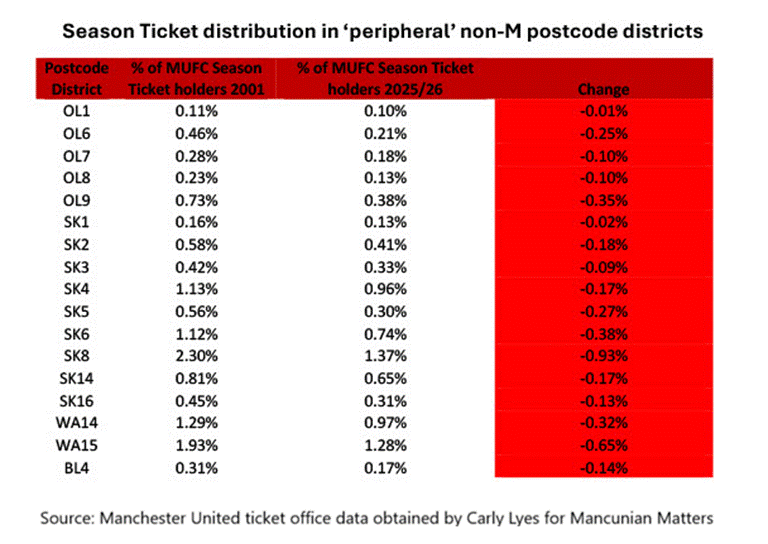
The original study also calculated percentages of season ticket holders in postcode districts adjoining Manchester, in an effort to capture the effects of ‘flight to the suburbs’ and other forms of ‘geographical social mobility’. In the 2025/26 analysis, we can see that in every one of these ‘peripheral’ postcode areas the overall proportion of season ticket holders has declined.
Finally, the 2021 study listed the overall proportion of season ticket holders resident in the North West of England, recognising ‘the dispersal of city communities and the influence of Manchester as the regional capital’. The North West in the original study is defined as encompassing the counties of Lancashire, Cheshire, Greater Manchester, Merseyside and Cumbria.
In 2025/25, the proportion of North West based season ticket holders from across those five countries had seen perhaps the biggest percentage drop of any group – from 72% in 2001, to just 52% in 2025/26.
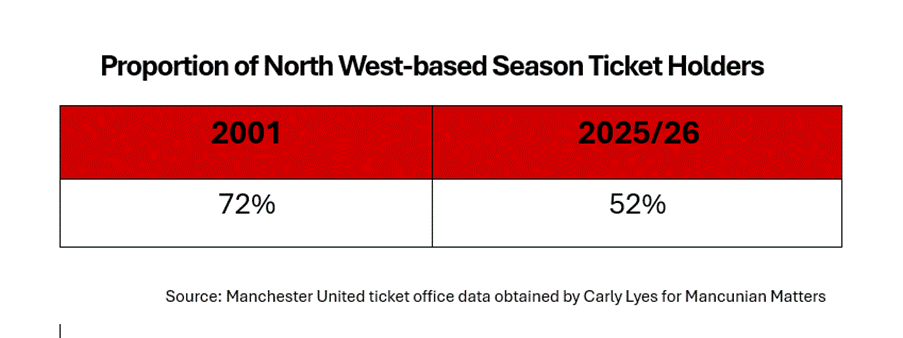
The data shows that season ticket holders now come from across the UK and abroad. In 2001, fans from outside of the North West region accounted for 28% of season ticket holders – in 2025/26, they accounted for 48% of season ticket holders. It appears that a tipping point is coming and if current trends continue, the season ticket holder base will soon reflect the stereotype that Dr Brown identified in the original study of “being more national and international than Mancunian”.
Why does all this matter? Why is there such attention on how many fans from the local area support Manchester United, or any other football club? Surely fans can support whichever club they want, wherever they want, and there shouldn’t be a hierarchy of importance about where fans come from if they’re paying customers and as long as they get behind their team? Manchester United have had fans from all over the country – and the world – for generations. National and international fans are warmly welcomed to Old Trafford by club and fans alike, and the club in particular proudly note that they have 362 official supporters’ clubs in no fewer than 95 countries.
Football clubs have, however, always traditionally represented their local communities. Manchester United was founded by railway workers in North Manchester in 1878. Like other football clubs, it has for generations been deeply rooted in the local community, with support passed on as a marker of identity and local pride through successive generations. Without local fans, football clubs risk moving away from being beloved institutions rooted in a deep sense of place, where fans pass down songs, rituals and folklore, and where rivalries with other clubs have a strong geographical element which gives colour and atmosphere to matches, towards being just brands with a sports club attached.
What is it that has made so many local fans stop coming to matches? I spoke to a number of fans from the local area to explore why there has been such a drop-off in season ticket numbers locally and regionally.
One of the main issues raised by local fans is pricing. In the 2000/01 season, the cheapest Old Trafford season ticket was £323. By 2026, the same ticket had doubled, costing £646. Alongside ticket price increases, they highlighted policies such as forced relocations – moving fans against their will to different parts of the stadium, breaking up communities and groups of friends who have sat together for many years, leading to some fans giving up their season tickets. Many expressed a sense that the club has become increasingly detached from local supporters.
Dave Pye, 52, from Stretford, has been a season ticket holder since he was a teenager. He feels there is ‘a disconnect between the club and the fans”. He say that a lot of his friends of a similar age don’t hold season tickets anymore “because of issues around ticketing – not being able to sit together in the stadium, pricing, and not being able to access away tickets”.
It’s a sentiment echoed by Peter Howarth, another season ticket holder from Stretford, who told me: “I think most fans are now of the opinion that United are trying to have more of this corporate image. I know for a fact there are a couple of people that live close to me who, when United started moving people’s seats around, from one place to another, became extremely disgruntled with it and gave up their season tickets as a result.”
One local fan who gave their season ticket up due to forced relocation was Anthony Murphy, born and bred in Old Trafford a stone’s throw away from the stadium. He was moved out of his seat – one of the cheapest in the stadium in the Scoreboard End – into a seat which cost £150 a season more. He has seen the number of his friends with season tickets who still live in Old Trafford dwindle down to just a handful over the past few years. “I reckon I know about three or four people who I grew up in the area of Old Trafford who are still season ticket holders. A lot of them have given it up over the years. That’s down to a number of things, but certainly mostly the expense.”
One of the biggest changes since 2001 which has affected fan relationships with the club came in 2005, when American businessman Malcolm Glazer undertook a hostile takeover of Manchester United. His leveraged buyout saddled the club with around £540 million in debt and caused many local fans to give up their season tickets in protest.
Peter said of the Glazer family: “There is still that undercurrent of ill feeling towards them. We saw the emergence of FC United and I know a good number of local lads who moved to FC United to start They were adamant at that time that they wouldn’t go back to United because of that.” FC United of Manchester, formed by disaffected former Manchester United season ticket holders in protest at the Glazer takeover, recorded average attendances of over 3,000 in their first season 2005/6.
James, 23, lives in Stretford and would love to hold a season ticket, but has been stuck for three years on what the club claim is a 150,000 fan season ticket waiting list. As an official member, he has to buy tickets game by game at prices much higher than those paid by season ticket holders. He believes the difficulty getting tickets alongside the high prices are putting off other young local Stretford residents from going to games.
James said: “I think local fans just don’t think Old Trafford is for them anymore. I live with 3 people, all Reds but none of them go to the match. They’ve made it too expensive for members, especially with the new price bands. I don’t know anyone paying £70/80. They can’t. One of them works nights in a warehouse and the other is on Universal Credit. That’s the reality for a lot of people here.”
Dave highlighted that he believes the decline in local fans holding season tickets is related to the ageing fanbase. “There’s a sort of natural decline – older fans can’t go anymore due to pricing or ill health, but younger fans can’t afford to take the season tickets off them, so you lose those young people and they go and do things that they can afford. Society has changed with regard to where people’s priorities lie. The club needs to think about where the next generation of season ticket holders will come from.”
Anthony agrees that younger local fans don’t take up those season tickets anymore as the club feels inaccessible to them. “Young people go into the match on a whim and then becoming regular punters at Old Trafford. School age lads here used to go together, they can’t afford to do that now, and can’t get tickets together. Local kids are not getting involved at such a young age anymore. It feels too inaccessible.”
James believes the club need to take action to support more local fans to attend games and make it easier for them to obtain season tickets. “I think the club should have something like Liverpool where they reserve a number of tickets for people with local postcodes. The membership system has absolutely no loyalty for people who regularly go to games or live locally.”
Whether Manchester United’s declining local season ticket base is the result of rising prices, changing demographics, ownership decisions or simply the realities of modern football is open to debate. The data alone cannot answer that question. What it does show, however, is that over the past quarter of a century the club’s matchgoing support has become markedly less local, despite tens of thousands of additional season tickets becoming available.
As United prepares to unveil the next stage of the biggest stadium project in its history, those figures raise an important question. A new 100,000-seat stadium may help regenerate a neighbourhood, but will it also strengthen the bond between the club and the community that created it? Manchester United has spent decades becoming a global institution. The challenge over the next 25 years may not be attracting supporters from the other side of the world, but ensuring that the children growing up within sight of Old Trafford still feel that it belongs to them too.
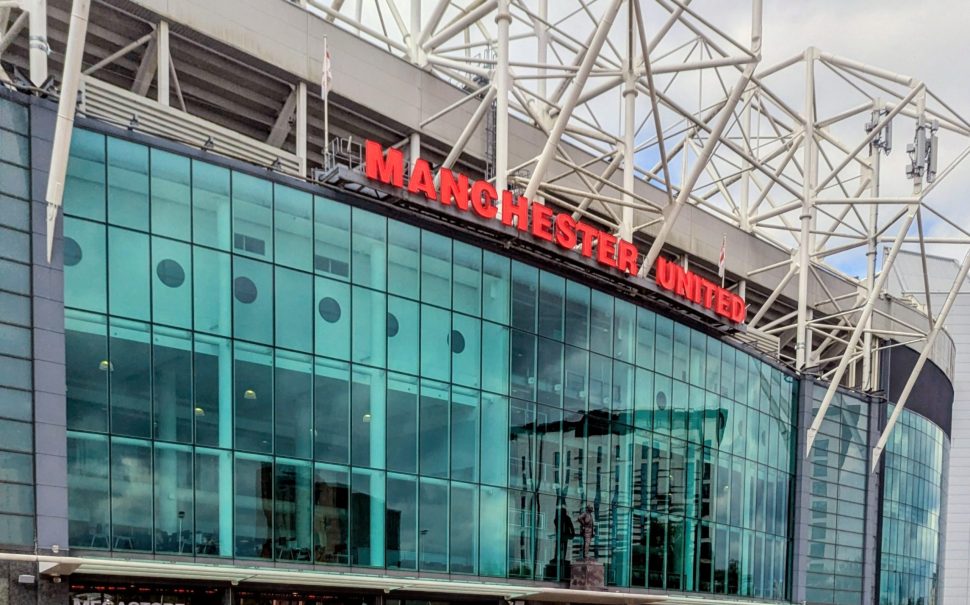
Featured image: Old Trafford Football Stadium, home of Manchester United Football Club. Image by Carly Lyes for MM.