Rapid improvements at the front of races are reshaping ambitions for everyday runners, who now see elite times as a target rather than a barrier.
Figures from the Great Manchester Run Half Marathon showed that the average pace for men in the top 1000 was cut from one hour 46 minutes and 28 seconds in 2021 to one hour 29 minutes and 27 seconds in 2025, while the women’s in the top 1000 improved from two hours 16 minutes and 41 seconds to one hour 46 minutes and 52 seconds over the same period.
While this could be seen as a deterrent for the more casual runners, it has had the opposite effect in recent years.
In fact, the Great Manchester Run Half Marathon saw its numbers grow by over 130% over the last five years to an impressive 35,000 participants.
This surge at the front has had a ripple effect, inspiring everyday runners to chase faster times and redefine what’s possible for them.
Wil Wilson Davies, 26, a casual runner who participated in the 2025 Manchester Half Marathon in May said: “Running is becoming more popular among the masses, and the benchmark for what’s considered ‘elite’ is now shifting as more and more people set the standard for a ‘normal time’ to what we would previously have seen as a time exclusively for pro runners.”
Wilson Davies brought his finishing time from 2:05:17 in his first Manchester half-marathon in November 2024 to 1:47:36 in the Great Manchester Run in May of this year.
He added that running is headed in the right direction, towards inclusivity and has not moved towards a competitive scene that intimidates newcomers, regardless of pace or age.
The data shows there was a significant pace improvement between 2021 and 2022 for the elite runners in the top 1000, with men shaving off over 10 minutes and women nearly 20 minutes from their previous averages.
The pace of improvement slowed, with smaller but consistent reductions in finish times each subsequent year and by 2025, the times have gradually approached a plateau.
Performance continues to improve, allowing casual runners to measure themselves against a higher standard.
Chris Knight, 26, is a personal trainer who participated in the 2025 Manchester Half Marathon, and finished in the top 1000 with a time of 01:27:43, putting him 224th in the men’s category.
He said: “Progress will always continue, but the rate will slow down very soon, there is always a limit to how much a human can improve.”
He added that: “As amateurs get faster, the definition of elite now means consistency over a prolonged period of time and prolonged exposure to races and ability to train at a high level all year round.”
The Great Manchester Run has become a stage where ambition spreads from top runners to casual participants, challenging the idea of what a typical finish looks like.
The instant availability of results and access to data lets everyday runners see how their pace stacks up against the top competitors.
Wilson Davies said: “Data adds a healthy competitive layer, where you can see the achievements of others and push yourself to reach goals you otherwise might not have seen as possible.”
While comparing themselves to elite runners can motivate casual participants, it also carries the risk of discouragement if the gap feels too wide or unattainable.
Knight said: “More runners compare themselves to these elite level runners.
“I was guilty of this, thinking if I trained harder I could hit those times.
“In reality, these elite level runners have been running in a structured environment since they were a child.”
Many runners now arrive on race day armed with detailed pacing plans inspired by the performances of the faster packs ahead of them.
The elevated standards have encouraged beginners to take recovery, nutrition, and strength work more seriously than ever before.
Training programs are becoming more structured for casual runners, including targeted intervals and strength routines that were previously considered “elite only”.
Wilson Davies outlined that races that once seemed niche now attract thousands of newcomers and a sense of collective achievement to every event.
He said: “Previously empty fun runs are now heaving with new faces, energy, and excitement across the globe.
“So many people I speak to have been dragged off the sofa, away from late nights in the pub toward early Sunday starts for a long-distance run, followed by a pint and a roast dinner.”
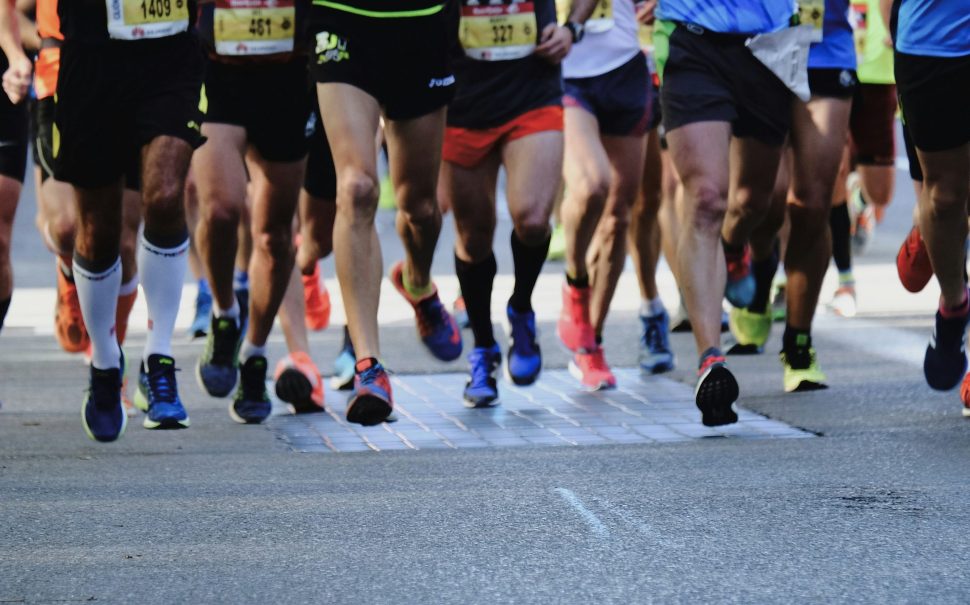
Featured image credit: Miguel A. Amutio via Unsplash