Misper (police slang for ‘missing person’), the debut feature of director Harry Sherriff and writer Laurence Tratalos, screened in competition at this year’s Manchester Film Festival to a sold-out crowd at HOME before taking home the award for Best UK Feature.
Set in a fading seaside hotel on the verge of foreclosure, Misper follows Leonard (Samuel Blenkin) as he and his co-workers navigate the aftermath of his colleague Elle’s (Emily Carey) disappearance.
What begins as an affectionate, wry exploration of British stoicism gradually unfolds into a formally ambitious portrait of collective loss. Misper blends crime, drama, comedy and media commentary into a tone that feels entirely singular. It’s a balancing act that could easily tip into inconsistency, but it’s this elasticity of tone that becomes the film’s defining strength.

Speaking after the screening, Sheriff and Tratalos were clear that resisting genre expectations was always the point.
“There’s so much of this true crime stuff out there,” Sherriff said. “We weren’t interested in the salacious, gratuitous version of these stories. What we were interested in was what it would really be like, and how this ominous, unsettling event would actually affect you.”
The result is a film that makes an incisive and timely statement about our true crime-obsessed media culture and its relationship to real loss. The film’s comedic edge is a surprising but effective counterbalance to this heavy premise, and that tonal range was particularly evident in the room at HOME.
“It’s very interesting, the different reactions you get to a film like this,” Sheriff reflected. “There are moments that some people laugh at and others don’t.”
Misper’s screening in Manchester was something of a homecoming for the pair, who are both from the North West and lived in Manchester when they met.
“It felt both really nice and also quite surreal,” Tratalos said.
The film’s subject matter inevitably resonates in a city shaped by collective experiences of loss. Sheriff is careful not to draw direct comparisons to specific tragedies, but he was working in Manchester at the time of the 2017 Arena attack and acknowledges how the film’s themes may land more deeply with local audiences.
“There is a loss, there’s a grief, there’s an anxiety,” he said. “It was a very eerie sort of absurd, dark experience for quite a few months. There were people who I worked with who came to the screening, and it was interesting to see how they saw the film.”
Central to Misper’s delicate approach is the choice to have Elle’s disappearance happen off-screen, save for an ominous set of headlights driving towards her bus stop. By refusing to centre the event itself and keeping it on the periphery, Misper becomes a study of response rather than incident, focusing on the aftermath of tragedy and how people behave in its shadow.
There is a quality to Misper and its characters that feels almost stubbornly real. Several lines of dialogue came directly from conversations with people encountered during production, and while the film’s characters are not based directly on specific individuals, they are assembled from real ones.
“They’re people we’ve all met in our lives,” Tratalos said.
“We like taking these odd, strange stories and rooting them in very real people,” Sherriff added.
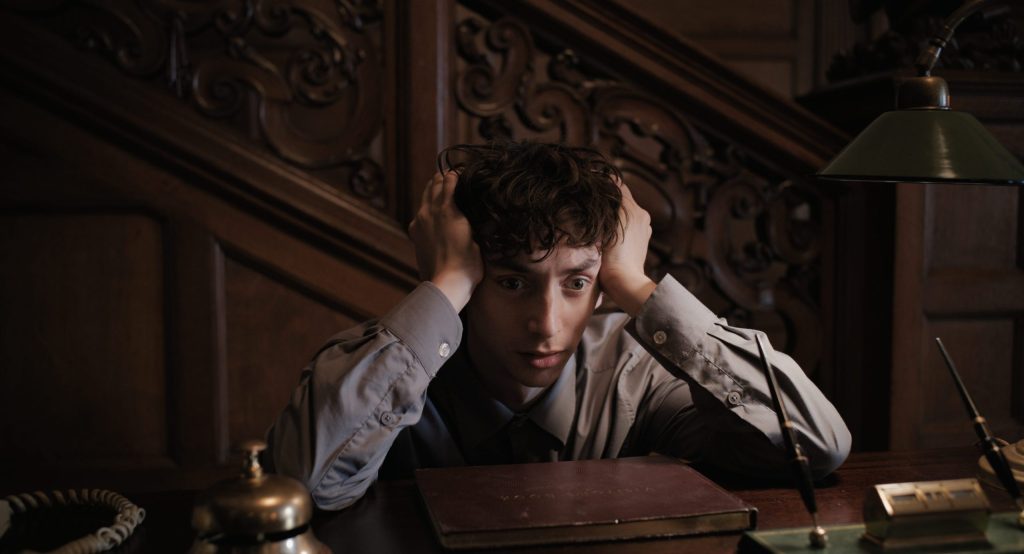
This commitment to realism is what gives the film its emotional weight, and at the centre of it all is Samuel Blenkin’s Leonard.
“His face is so expressive,” Sheriff said. “Sam’s so good at the below-the-surface stuff. You didn’t even have to say anything; it’s there on him.”
Blenkin carries the film largely through implication, delivering a performance that is both sensitive and restrained, with an expert balance of deadpan humour and sincerity.
Around him, the rest of the supporting cast offers a series of understated, unexpectedly touching performances. Stand-out Daniel Ryan’s Gary, the beleaguered hotel manager holding on to every last shred of professionalism, finds humour and pathos in equal measure, while Christine Bottomley brings an entire interior life to her role as Viv with the economy of a single look.
Emily Carey, present only for a few days of shooting, leaves an impression that persists throughout the film – a testament to both her performance and to the screenplay’s discipline in keeping Elle’s absence felt rather than explained.
For this, Sheriff and Tratalos are generous in their praise for casting director Verity Norton.
“She was never wrong,” Sheriff said. “She just saw the potential in all of them. We’re very lucky to have her.”
Despite its distinctly British sensibility, the filmmakers are optimistic about how Misper will translate to audiences further afield.
“The themes are universal,” Sheriff said. “This unrequited sort of friendship… the more you make something specific and weird, I think the more universal it’ll be.”
He elaborated on why: “When you do make those kinds of weirder, more niche stories, people will see themselves reflected back in that – because we’re all so weird, and so odd and distinct.”
There’s a sense of loss that runs through Misper that has no postcode, and in that sense, it couldn’t be more universal. It is an endearing debut with an excellent screenplay that masters both weight and warmth, only elevated further by a cast of deeply felt, sincere performances.
Misper won Best UK Feature at the Manchester Film Festival 2026 and will screen at festivals across America later in the year.
Featured Image: Still from ‘Misper’ / Fresh Orange Productions